
About
A focused, founder-led practice
Ekoya Land Systems exists to make nature visible, decision-relevant, and actionable — combining ecosystem science, spatial analysis, land management, planning, and implementation in one practice.
Our story
From research to real decisions
Ekoya grew out of years of applied and academic work on how landscapes function — and how that knowledge can change decisions on the ground. Too often, the value of nature is understood by scientists but missing from the plans, budgets, and operations that shape land.
Ekoya was founded to close that gap: a specialist practice that brings spatial ecosystem intelligence directly into planning, policy, investment, and management, and stays involved through implementation and monitoring.
Mission
Make nature visible, decision-relevant, and actionable.
We help people and organizations understand how their land and operations depend on nature — and turn that understanding into better planning, management, investment, and implementation decisions.
Vision
Landscapes and operations where nature is part of every decision.
A future where resilient landscapes, responsible operations, and nature-positive action are the norm — because the evidence for them is clear, shared, and used.
How Ekoya Works
Principles That Guide Every Engagement
Ekoya combines rigorous spatial analysis with practical understanding of policy, land management, operations, and implementation. These principles shape how each project is designed, delivered, and communicated.
-
01
Decision-led
We begin with the decision, not the tool.
We clarify the decision, intended users, geographic scale, constraints, and desired outcome before selecting data, models, or methods.
-
02
Focused expertise, connected capability
Deep specialization supported by the right collaborators.
Ekoya brings focused expertise in ecosystem services, natural capital, spatial planning, biodiversity, climate resilience, and science-policy translation. Where a project requires complementary expertise, we build the right team around the challenge.
-
03
Place-based and spatially grounded
Evidence is connected to real landscapes and operating contexts.
We consider scale, ownership, governance, land use, ecological processes, beneficiaries, and uncertainty so recommendations reflect how a place actually functions.
-
04
Designed for implementation
Every output should support a next decision or action.
Maps, models, and reports are developed to inform policy, planning, management, investment, funding, nature-based solutions, and monitoring—not simply to document existing conditions.
-
05
Shared evidence, tailored decisions
A common evidence base can support different responsibilities.
We create transparent baselines that partners can understand and use together, while tailoring recommendations to each organization’s mandate, authority, risks, and opportunities.
-
06
Clear and credible communication
Complex evidence should remain understandable, traceable, and useful.
We explain methods, assumptions, limitations, and uncertainty clearly, connect conclusions to evidence, and develop communication products appropriate for technical, executive, partner, and public audiences.

Ehsan Pashanejad, PhDFounder and Principal
- Ecosystem services & natural capital
- GIS, remote sensing & spatial modelling
- Biodiversity & ecological connectivity
- Climate adaptation & nature-based solutions
- Urban & agricultural landscape planning
- Science-policy translation & implementation
Founder and Principal
Ehsan Pashanejad, PhD
Ehsan Pashanejad earned his PhD in Earth and Environmental Sciences from the University of British Columbia, specializing in ecosystem services, spatial planning, ecological connectivity, and the translation of landscape science into policy and management decisions. He works at the science–policy–practice interface, helping governments, farmers, land managers, conservation organizations, and nature-dependent businesses turn complex ecological and geospatial evidence into practical planning, investment, policy, and operational decisions. His experience spans agricultural landscapes, urban nature, climate resilience, natural capital, biodiversity, and nature-based solutions.
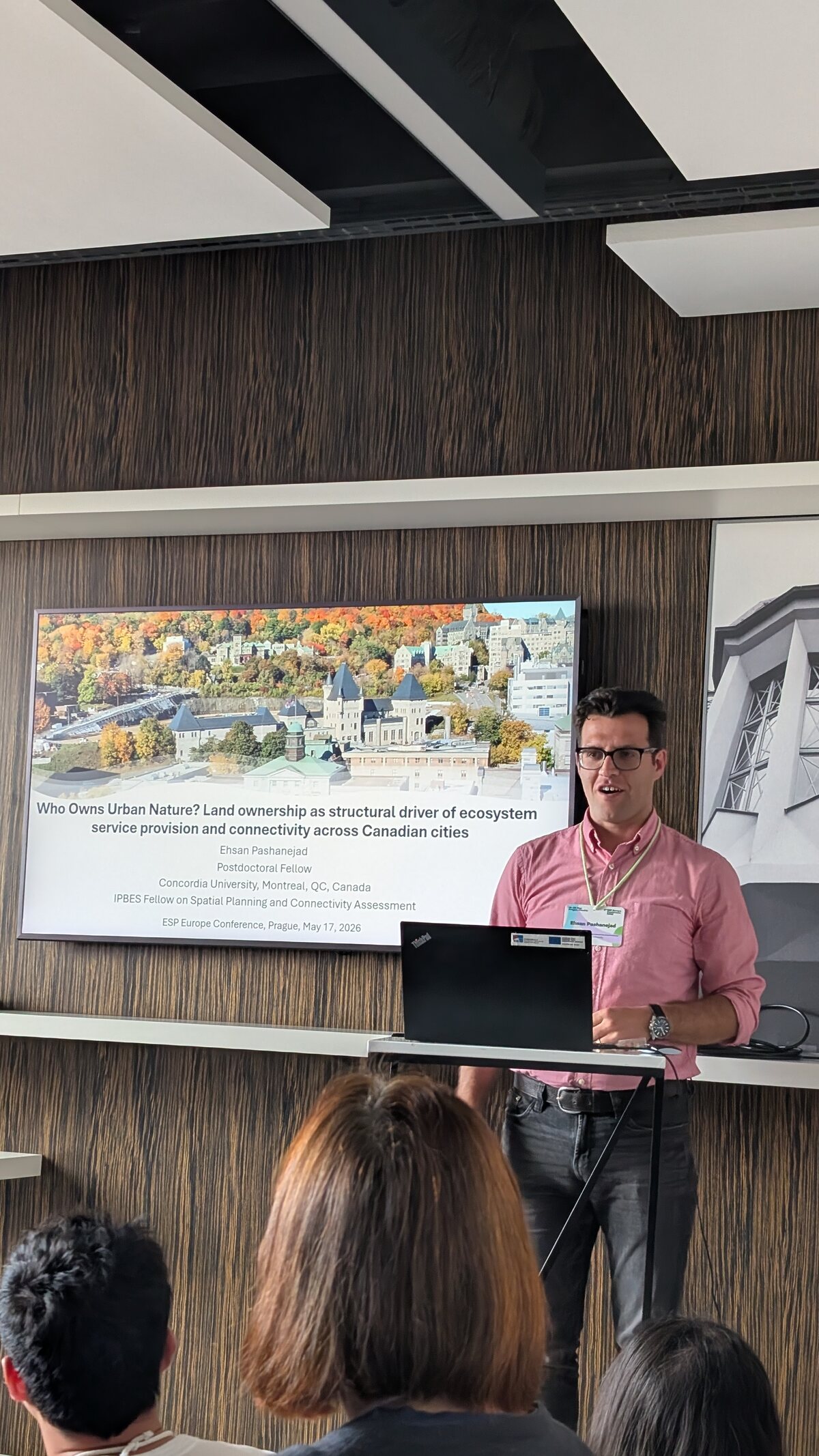
As a Fellow with the Intergovernmental Science-Policy Platform on Biodiversity and Ecosystem Services (IPBES), Ehsan contributes to the global methodological assessment on biodiversity-inclusive spatial planning and ecological connectivity. This work gives Ekoya direct experience with international evidence standards, global biodiversity policy, and the challenge of translating science into options that decision-makers can use. Ehsan is also a Postdoctoral Fellow at Concordia University, where he leads research examining how land ownership and urban form influence ecosystem services and ecological connectivity across Vancouver, Montreal, and Quebec City. His previous experience includes work with Agriculture and Agri-Food Canada, Parks Canada, the Canadian Agri-Food Policy Institute, the Okanagan Collaborative Conservation Partnership, and the Comox Valley Land Trust.
He serves on the Executive Committee of the Young Ecosystem Services Specialists (YESS) Network, an international professional network connecting emerging researchers and practitioners working to advance ecosystem-services science and its practical application.
Why this experience matters
Global standards, applied to your landscape
Ekoya’s work is held to the same evidence standards used in international science-policy assessments — then brought down to the scale of a watershed, a farm, or a city.
Through the IPBES global assessment on biodiversity-inclusive spatial planning, Ehsan works with the methods and evidence standards that governments rely on worldwide. That is what lets Ekoya turn complex ecological science into options a local council, a producer group, or a land trust can act on — rigorous enough to defend, and plain enough to use.
Networks & affiliations
The networks behind the practice
Ekoya draws on active roles in international science-policy networks — and applies their methods and standards directly to local and regional decisions.
Intergovernmental Science-Policy Platform on Biodiversity and Ecosystem Services
IPBES
Contributes international assessment experience in biodiversity-inclusive spatial planning, ecological connectivity, and translating scientific evidence into policy-relevant options.
International Institute for Applied Systems Analysis
IIASA
Developed systems-analysis and scenario-modelling experience for understanding trade-offs among agricultural production, biodiversity, and landscape change.
Canadian Agri-Food Policy Institute
CAPI
Translated agricultural landscape research into accessible policy recommendations and supported dialogue among producers, conservation organizations, and policy participants.
Towson University
Maryland, United States
Built international collaboration and knowledge exchange in systems ecology, spatial analysis, and regional planning.
Young Ecosystem Services Specialists Network
YESS
Provides international professional leadership and collaboration across ecosystem-services science, practice, and knowledge exchange.
Collaboration model
Direct involvement, with the right expertise for each project
Ekoya is a small, specialist consultancy. Ehsan works directly with clients throughout each project—from defining the scope and analytical approach to interpreting results and preparing recommendations. This continuity helps ensure that the project context, technical work, and client priorities remain closely connected.
Where additional expertise is needed, Ekoya collaborates with independent specialists in areas such as forestry, engineering, economics, community engagement, and advanced modelling. These collaborators are engaged based on the specific needs of the project, with their roles and responsibilities clearly defined. This approach allows Ekoya to provide focused senior-level attention while assembling the appropriate expertise for more complex assignments.
Start with the decision
Let’s talk about your landscape.
Whether you’re a farmer, an agency, a business, or a conservation group, Ekoya can help you turn nature into better decisions.